Research
A living lab for climate-resilient olive farming in northeastern Spain: six management systems implemented and compared side by side under the same environmental and socio-economic conditions.
- December 2025 Farm purchased.
- 2026–2028 Consortium formation, funding applications, design phase and gathering baseline data; farm maintenance by the contract worker.
- Around 2028 Implementation of the six management systems (depending on funding and administrative processes).
- Long term Monitoring, research and demonstration.
Why we research
Olive farming in the Mediterranean is under growing climate pressure. Farmers in the region are willing to change their practices — but they need to see it: to experience what different management strategies do both ecologically and economically, and to get economic certainty that the investment pays off.
Tierra de Esperanza closes that adoption gap by making the evidence visible, on the ground, in the region itself.
How we work
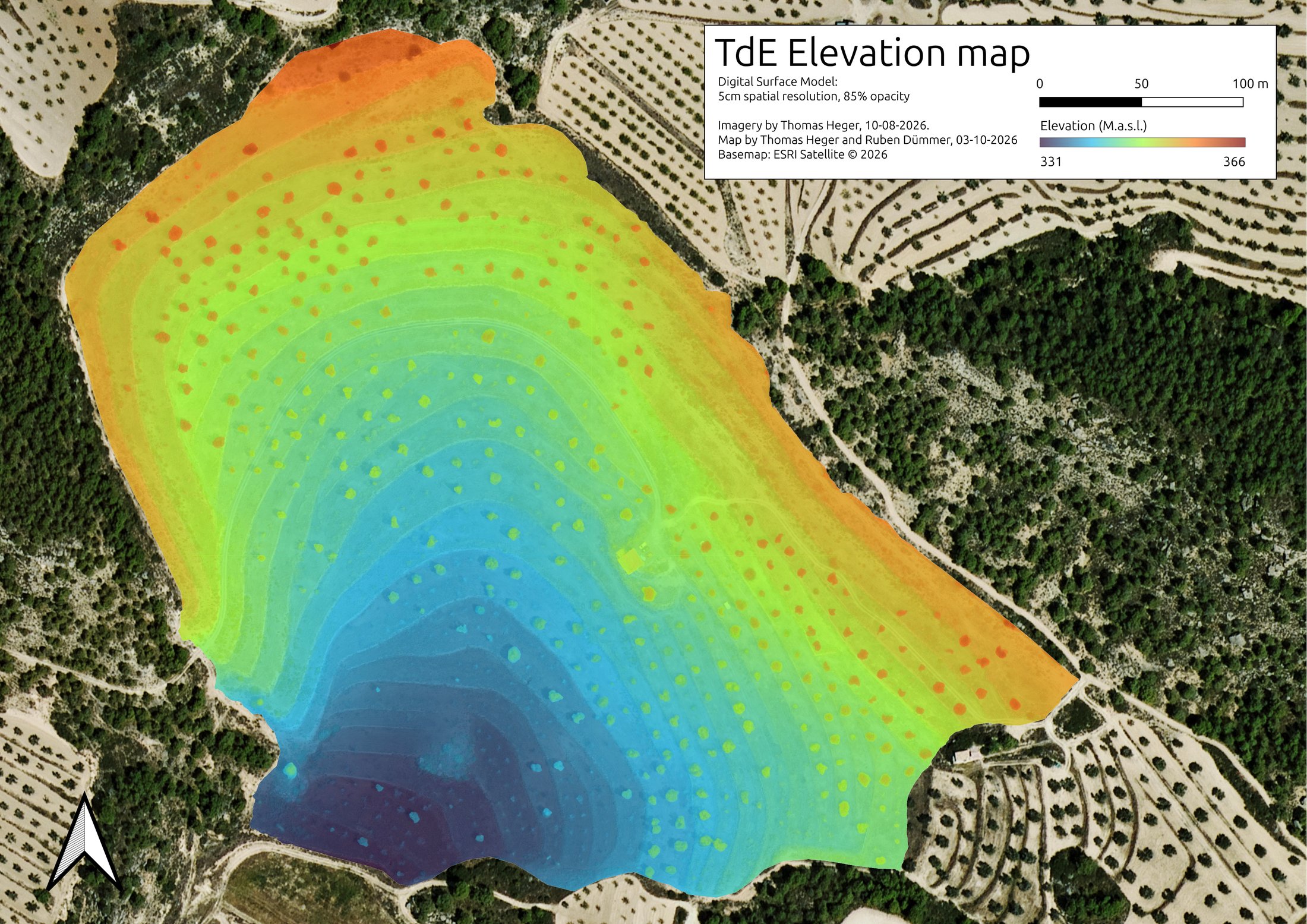
The farm is a living laboratory: a research site for data generation and a demonstration site — a hub for local farmers and landowners. We track key indicators across all systems:
Water retention
Yield & quality
Biodiversity
Economic performance
Design of the living lab
Six management systems are implemented and compared side by side under the same conditions:
- Traditional management as done in the region (baseline)
- Organic
- Regenerative agriculture
- Nature-inclusive
- Food forest
- Agroforestry / silvopastoral systems
Expected outputs
Comparative datasets across farming systems; scientific publications and applied reports; demonstration days for farmers and stakeholders; and contributions to regional and EU-level agricultural discussions.
Biodiversity snapshot
30
species observed on the farm so far
7
groups — plants, birds, insects and more
10
birds, incl. booted eagle, griffon vulture and short-toed snake eagle
| Name | Latin | Group | Observed | Link |
|---|---|---|---|---|
| Common toad Dutch: Gewone pad | Bufo bufo | Amphibian | 19 nov 2026 | Wikipedia |
| Booted eagle Dutch: Dwergarend | Hieraaetus pennatus | Bird | 11 aug 2026 | Wikipedia |
| Cirl bunting Dutch: Cirlgors | Emberiza cirlus | Bird | 11 aug 2026 | Wikipedia |
| Eurasian griffon vulture Dutch: Vale gier | Gyps fulvus | Bird | 11 aug 2026 | Wikipedia |
| European bee-eater Dutch: Bijeneter | Merops apiaster | Bird | 20 nov 2026 | Wikipedia |
| European red-rumped swallow voorheen C. daurica; Dutch: Roodstuitzwaluw | Cecropis rufula | Bird | 20 nov 2026 | Wikipedia |
| Hoopoe Dutch: Hoop | Upupa epops | Bird | 20 nov 2026 | Wikipedia |
| Lesser whitethroat Dutch: Kleine zwartkop | Sylvia curruca | Bird | 11 aug 2026 | Wikipedia |
| Short-toed snake eagle Dutch: Slangenarend | Circaetus gallicus | Bird | 11 aug 2026 | Wikipedia |
| Western barn owl (barn owl) Dutch: Kerkuil | Tyto alba | Bird | 12 aug 2026 | Wikipedia |
| Woodchat shrike Dutch: Roodkopklauwier | Lanius senator | Bird | 20 nov 2026 | Wikipedia |
| Buff-tailed bumblebee Dutch: Aardhommel | Bombus terrestris | Insect | 19 nov 2026 | Wikipedia |
| Churchyard beetle Dutch: Zwartlijf | Blaps lusitanica | Insect | 19 nov 2026 | Wikipedia |
| Digger wasp determinatie onzeker, obv locatie; Dutch: Sabelsprinkhanendoder | Sphex funerarius | Insect | 19 nov 2026 | Wikipedia |
| European mantis Dutch: Europese bidsprinkhaan (eipakket) | Mantis religiosa | Insect | 12 aug 2026 | Wikipedia |
| Harvester ant Dutch: Oogstmier | Messor barbarus | Insect | 19 nov 2026 | Wikipedia |
| Paper wasp genusniveau; Dutch: Veldwesp | Polistes spp. | Insect | 19 nov 2026 | Wikipedia |
| Red-veined darter Dutch: Zwervende heidelibel | Sympetrum fonscolombii | Insect | 11 aug 2026 | Wikipedia |
| Millipede rutilans of moreletii; Dutch: Miljoenpoten | Ommatoiulus spp. | Millipede | 19 nov 2026 | Wikipedia |
| Common yellow scorpion vermoedelijk; Dutch: Gele schorpioen | Buthus occitanus | Other invertebrate | 1 nov 2026 | Wikipedia |
| Broomrape Dutch: Rozemarijnbremraap | Orobanche latisquama | Plant | 19 nov 2026 | Wikipedia |
| Cade juniper, prickly juniper Dutch: Stekeljeneverbes | Juniperus oxycedrus | Plant | 22 aug 2026 | Wikipedia |
| Distel humilis?; no common English name; Dutch name used; Dutch: Distel | Atractylis spp. | Plant | 19 nov 2026 | Wikipedia |
| Drietandkogelbloem no common English name; Dutch name used; Dutch: Drietandkogelbloem | Globularia alypum L. | Plant | 10 aug 2026 | Wikipedia |
| Dwarf everlast Dutch: Zandstrobloem | Helichrysum arenarium L. | Plant | 10 aug 2026 | Wikipedia |
| Goudscherm no common English name; Dutch name used; Dutch: Goudscherm | Bupleurum rigidum | Plant | 19 nov 2026 | |
| Mastic tree Dutch: Mastiekboom | Pistacia lentiscus | Plant | 19 nov 2026 | Wikipedia |
| Phoenicean juniper Dutch: Fenicische jeneverbes | Juniperus phoenicea | Plant | 22 aug 2026 | Wikipedia |
| Sisallo op Wikipedia als Caroxylon vermiculatum; no common English name; Dutch name used; Dutch: Sisallo | Salsola vermiculata | Plant | 19 nov 2026 | Wikipedia |
| Algerian psammodromus Dutch: Algerijnse zandloper | Psammodromus algirus | Reptile | 19 nov 2026 | Wikipedia |
Collaborations & partners
We are forming a consortium of research partners and funders. Partners can run their own experiments — for example in integrated pest management or plant breeding — within the Tierra de Esperanza research framework.
Interested? Contact us by email.